

ECN vs Market Maker Brokers (2026 Comparison Guide)
Updated 2026 • Independent Analysis • ReviewBrokers.net
What Is an ECN Broker?
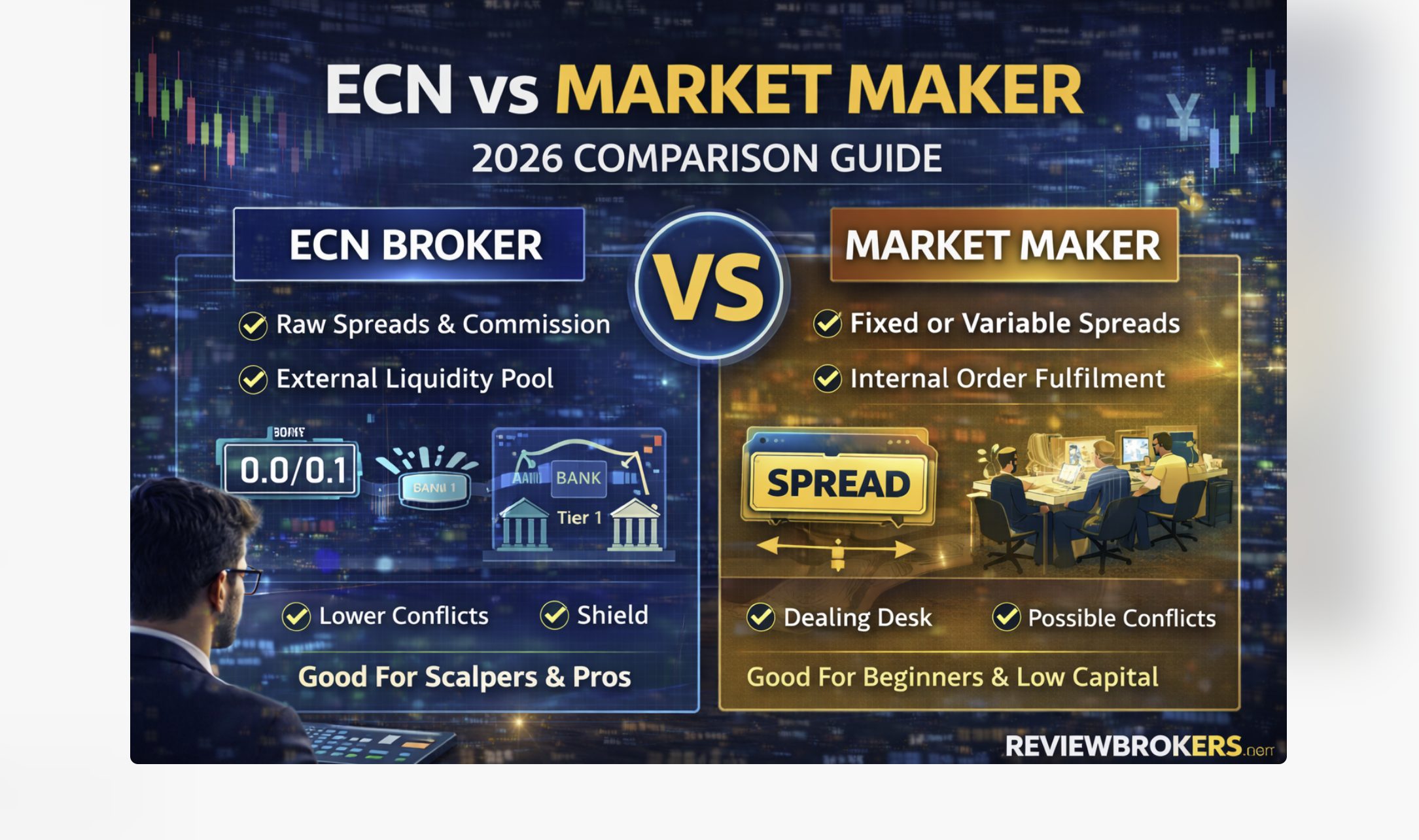
An ECN (Electronic Communication Network) broker connects traders directly to liquidity providers such as banks, hedge funds, and other market participants.
- Orders are matched within a liquidity pool
- Spreads are typically raw (variable)
- Commission is charged per lot
- No dealing desk intervention
Execution depends on the broker’s infrastructure and liquidity aggregation system.
Learn more in our technical breakdown:
How Forex Broker Infrastructure Works
What Is a Market Maker Broker?
A Market Maker broker internally creates liquidity and may take the opposite side of client trades.
- Fixed or variable spreads
- Usually commission-free accounts
- Orders may be filled internally
- Potential conflict of interest exists
Market makers are not inherently unsafe, but regulatory oversight becomes more important.
See:
How Broker Regulation Works in 2026
ECN vs Market Maker: Side-by-Side Comparison
| Feature | ECN Broker | Market Maker |
|---|---|---|
| Spread | Raw (0.0–0.3 pips typical) | Fixed or slightly wider |
| Commission | $5–$8 per lot | Usually included in spread |
| Execution Model | External liquidity pool | Internal dealing desk possible |
| Conflict of Interest | Lower structural conflict | Possible (if internalized) |
| Best For | Scalpers, algorithmic traders | Beginners, small accounts |
Cost Comparison Example (100 Lots per Month)
| Model | Spread Cost | Commission | Total Monthly Cost |
|---|---|---|---|
| ECN (0.2 pip avg) | $200 | $700 | $900 |
| Market Maker (1.2 pip avg) | $1,200 | $0 | $1,200 |
Although ECN brokers charge commission, total cost can be lower due to tighter spreads.
Understanding Liquidity Providers
Execution models depend heavily on how brokers source liquidity.
For a deeper breakdown of Tier-1 banks, Prime of Prime providers, and liquidity aggregation,
read our full guide:
Liquidity Providers Explained (2026 Guide)
Which Is Safer in 2026?
Safety depends more on regulation than execution model.
- Tier-1 regulated ECN → Generally strong protection
- Tier-1 regulated Market Maker → Also acceptable
- Offshore broker (any model) → Higher risk
We evaluate brokers using a structured scoring system:
How We Evaluate Forex Brokers (Methodology 2026)
When Should You Choose ECN?
- High-frequency scalping
- Algorithmic trading
- Large trading volume
- News trading strategies
When Should You Choose Market Maker?
- Beginner traders
- Low capital accounts
- Traders preferring fixed spreads
Common Misconceptions
“ECN Brokers Never Trade Against You”
Some brokers advertise ECN status but partially internalize flow. Transparency and regulation matter more than labels.
“Market Makers Are Scams”
Not necessarily. Many globally regulated brokers operate hybrid models legally.
Final : ECN vs Market Maker in 2026
There is no universal “better” model. The right choice depends on:
- Your trading frequency
- Account size
- Risk tolerance
- Broker regulation quality
- Execution infrastructure
In 2026, traders should focus less on marketing labels and more on measurable factors:
- Average spread data
- Slippage transparency
- Commission structure
- Regulatory standing
For deeper technical insight, explore: